Kansas Financial Literacy Standards
Kansas is one of the few U.S. states that merits an “A” grade for its school financial education standards, according to the American Public Education Foundation (APEF). The APEF grades every state, DC, and Puerto Rico for their school personal finance guidelines in its biannual publication, “The Nation’s Report Card on Financial Literacy.”
The Sunflower State earned the “A” because it requires completion of a standalone personal finance course for high school graduation; has financial literacy standards in place for grades K-12; and sponsors a Financial Literacy Website. Kansas statutes mandate that “the state board of education shall develop state curriculum standards for personal financial literacy, for all grade levels, within the existing mathematics curriculum or another appropriate subject-matter curriculum.” These standards are recognized in the Business, Family and Consumer Sciences, Mathematics, and Social Studies strands.
KS Financial Education Standards by Grade Level
Although not specifically set for each grade level, the APEF considers the Kansas standards to be comprehensive and provide an excellent foundation in the lower and middle grades in advance of the required course in high school. As stated in Kansas Statute, Article 32, “The state board of education shall encourage school districts when selecting textbooks for mathematics, economics, family and consumer science, accounting or other appropriate courses, to select those textbooks which contain substantive provisions on personal finance, including personal budgeting, credit, debt management and other topics concerning personal financial literacy.”
The statute also mandates that “the state board of education shall include questions relating to personal financial literacy in the statewide assessments for mathematics or social studies.” It is unclear how financial literacy is tested in the statewide assessments. Statewide assessments are given in grades 3-8 and 10; and the Mathematics and ELA standards on which those assessments are based do not include financial literacy.

Recommended Policy for KS Financial Literacy Programs
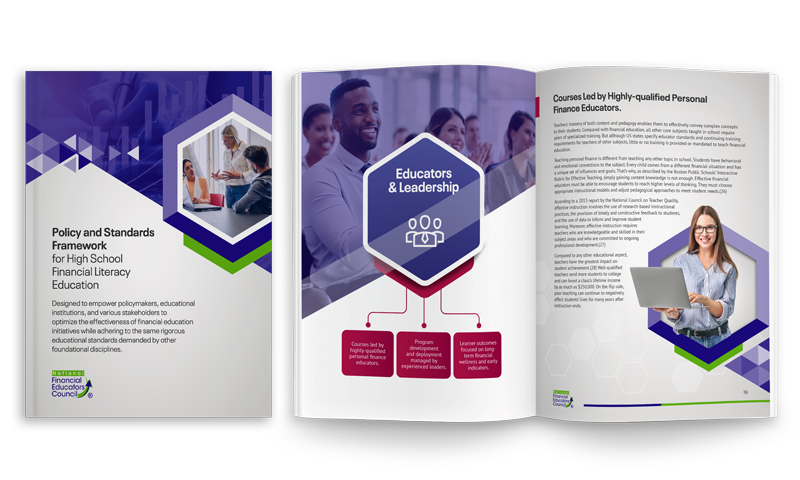
To address the gap in standards for personal finance education, the National Financial Educators Council has developed a set of benchmarks for all grade levels, K-12. This policy guide offers legislators a framework that standardizes educational quality and learner outcomes to provide the best possible financial education for American youth.
The Standards Guide is based on the notion that financial education should be treated with the same rigor as any other topic taught in schools and that all students should be capable – at minimum – of making near-term financial decisions.
National Standards for Financial Education
Financial Literacy Standards for Older Youth & Adults (High School through Adults)
Although there is no direct mandate by the Kansas State Board of Education, it is recommended that national standards be implemented. Financial education is a unique subject; all participants have developed financial habits and relationships with money before instruction begins.
National standards are those that have been proven in empirical and theoretical research to produce the highest improvements in participant test scores.

Financial Literacy Standards for Kids (Kids PK through 8th Grade)
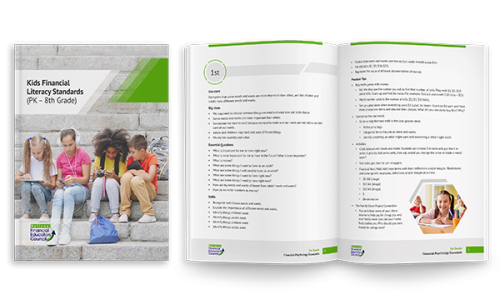
In collaboration with education leader Heidi Jacobs, the NFEC created these financial literacy standards to define learning goals and educational targets for optimal child financial education. Guided by strong pedagogical theory, the standards ensure that instructional targets are age- and developmentally-appropriate and that lessons can be effectively scaffolded. Standards represent five sections based on topic areas in the NFEC curriculum.

Standards for Financial Education Instructors
The NFEC teamed with the well-known Danielson Group to develop the first and only national standards for financial educators – The Framework for Teaching Personal Finance – to define optimal educator skill sets and performance levels. The framework also identifies the financial educator responsibilities empirically proven to produce highest gains in participant test scores. This framework is used in all 50 states, including Kansas.